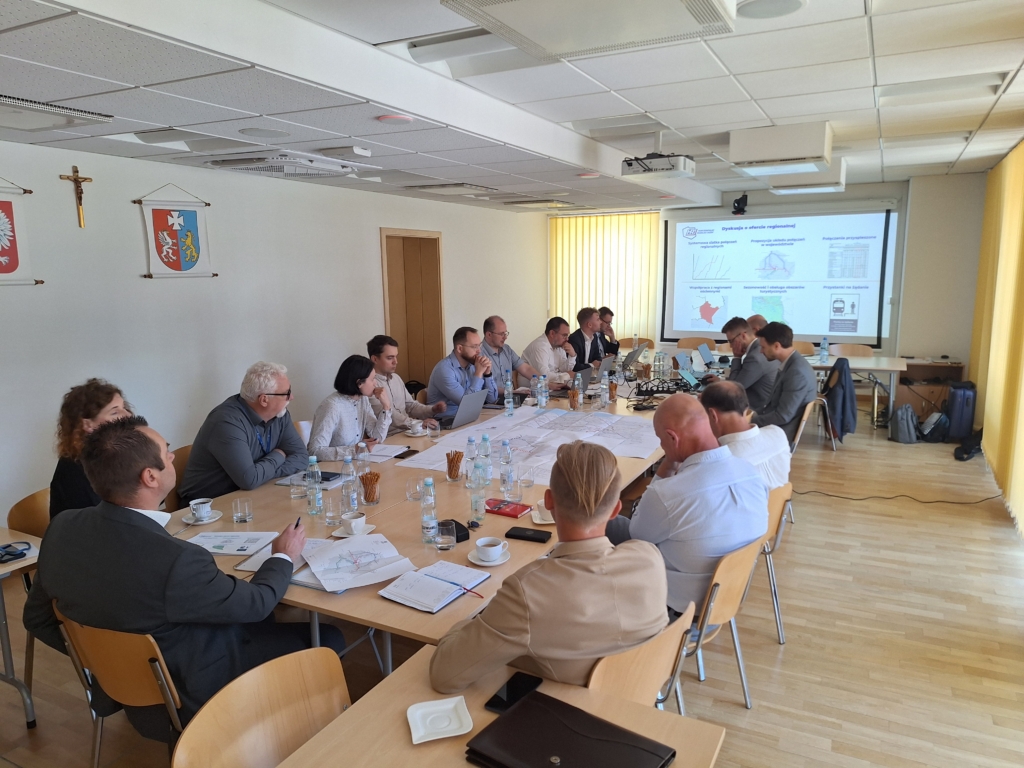
The Horizontal Timetable passes the halfway mark in consultations with regional and metropolitan transport authorities
In the first week of August 2025, the Horizontal Timetable (HRJ) team lead a workshop with representatives of the Marshal's Office of the Silesian Voivodeship and the Upper Silesian-Zagłębie Metropolis. This milestone signifies that the consultations with regional and metropolitan transport authorities have now passed their halfway point.
The consultation process began in April 2025 with the team’s visit to the Marshal’s Office in Szczecin (April 16th). Subsequent meetings were held in Zielona Góra (May 9th ), Łódź (May 22), Olsztyn (June 9th ), Rzeszów (June 18th), Lublin (June 24th), Poznań (July 2–3rd), Kraków (July 14th), Toruń (July 24th), and Katowice (August 4–5th). The remaining consultations across other voivodeships are scheduled to be completed by early October 2025.
The HRJ team is represented by the Ministry of Infrastructure, Centralny Port Komunikacyjny (CPK), the Centre for EU Transport Projects (CUPT), and PKP Polskie Linie Kolejowe (PLK S. A., infrastructure manager) – institutions that significantly influence the organization and operation of long-distance rail services in Poland. This cross-institutional collaboration ensures coherence in carried works.
Each workshop is structured into two key parts:
1) Presentation and discussion of remarks from regional transport authorities regarding the long-distance rail offer.
2 )Review of the planned regional transport services in terms of their coordination with the long-distance network.
This process aims to build a coherent national passenger rail system through long-term service and timetable planning. Such coordination is particularly important in the context of the planned increase in both long-distance and regional train services on certain routes, which face existing infrastructure constraints.
During the 1st part of the workshops on long-distance services, the HRJ team presents detailed blueprint for each railway corridor running through the respective voivodeship. Regional transport authorities have the opportunity to propose adjustments to corridor layouts, stopping patterns, or service frequency.
In the 2nd segment focused on regional services discussions are based on initial service concepts submitted by all 16 voivodeship-level organizers, as well as by the Warsaw Public Transport Authority (ZTM) and the Upper Silesian-Zagłębie Metropolis. These discussions covers the layout and frequency of services, potential for intermodal integration, seasonal (tourist) demand, and long-term plans for the reactivation of railway infrastructure.
The consultations led by the HRJ team with regional and metropolitan transport authorities represent one of four key paths in the development of the Horizontal Timetable. Other paths include public consultations, discussions with prospective operators, and coordination with neighboring countries.
The outcome of this process will be a revised structure of railway corridors, to be finalized and publicly presented in Q4 2025. Ultimately, the planners aim to establish a stable and consistent timetable framework for the years 2031–2035, aligned with infrastructure capabilities and providing a coherent national network of both long-distance and regional rail services.