

Consultation Plan
As part of the Horizontal Timetable project, it was assumed that the consultation process is as important as the analyses themselves. Thanks to broad consultations, this is the first time in Poland that a nationwide long-distance rail service network is being prepared in a transparent process, with the participation of the public and key stakeholders in the railway market.
The Horizontal Timetable is being developed several years in advance. This makes it possible to carefully prepare the proposed solutions, analyse different variants and take into account the opinions of passengers, non-governmental organisations (NGOs), public transport authorities, railway undertakings and international partners.
The consultations were divided into two main groups:
- public consultations – open to any interested individual or entity,
- sectoral consultations – addressed to key entities that are current or potential stakeholders in the passenger rail market.
Public consultations
All interested residents of Poland, as well as NGOs, expert and sectoral organisations, and representatives of the scientific and technical community were invited to take part in the public consultations. Their purpose was to collect opinions, comments and proposals concerning the proposed long-distance service network and the assumptions of the Horizontal Timetable. More information is available on the Public consultations page.
Sectoral consultations
Sectoral consultations were held with key entities influencing the organisation and functioning of the passenger rail market. They covered three main paths:
- coordination of long-distance services with regional and metropolitan services – with the 16 regional governments, the Warsaw Public Transport Authority and the Upper Silesian and Zagłębie Metropolis, which, alongside the minister responsible for transport, are the key public transport authorities responsible for passenger rail services in Poland. More information on this consultation path is available on the Consultations with public transport authorities page,
- market organisation rules from 2030 onwards – with current and potential railway undertakings, including foreign entities. More information on this consultation path is available on the Consultations with potential operators page;
- coordination of international services – with the relevant foreign entities, including ministries, infrastructure managers (mainly as part of the Eurolink project), or railway undertakings, depending on the model of service organisation adopted in a given country. The purpose of this consultation path was to agree on consistent assumptions for international train routes and border crossing points with the railway networks of neighbouring countries. More information is available on the International consultations page.
Comments, proposals and requests submitted by participants in all consultation paths were analysed and taken into account in the update of the Horizontal Timetable.
Public Consultations
We have completed public consultations on the assumptions for the level of services under the Horizontal Timetable for the 2034/2035 timetable. A total of 1,347 forms were submitted via the online form, containing 1,811 comments. We would like to thank everyone for their involvement and participation in the development of HRJ. The submitted proposals were analysed, and the conclusions from the consultation process are presented in the report.
The purpose of the public consultations was to collect the widest possible range of opinions from passengers, representatives of local government units, NGOs, expert and sectoral organisations, and the scientific and technical community on the general assumptions for the level of services. The public consultations covered the draft service line diagram, including service frequencies and assumptions concerning commercial stops for the 2034/2035 timetable, the so-called Horizon 2035, in the working version as of 16 July 2024.
Horizon 2035 is the most representative time horizon in the context of the project’s objectives, due to the stabilised assumptions concerning the future shape of the Polish railway network. By that time, the entire “Y” high-speed rail system is expected to be put into operation. It consists of a common corridor from Warsaw to Sieradz via the new airport developed under the Port Polska investment programme and Łódź, as well as western extensions from Sieradz to Poznań via Kalisz and to Wrocław.
The subject of the public consultations was material published as a single presentation of the assumptions for the level of services, together with a service diagram. Since each form could contain several comments, individual items were separated in order to organise the collected material. As a result, a total of 1,811 comments were identified.

1,099 comments concerned the routes of service lines presented in HRJ. Specific proposals for new connections accounted for a further 191 comments. General proposals accounted for another 440 comments, including 122 concerning transport needs without indicating specific solutions. Finally, 81 proposals concerned passenger service points.
A summary of the analytical work carried out in order to develop the new version of HRJ showed that approximately 60% of the proposals included in the submitted comments were implemented in full or in part.
The result of all four consultation paths is a modification of the service line layout. This includes, in particular, the introduction of a separate category of supplementary fast services, optimisation of services on the “Y” high-speed rail line, more stops for express trains, more lines using high-speed rail infrastructure while also serving medium-sized towns, the inclusion of non-system services in the service network, and better coordination with the regional segment.
Report on the Public Consultations of the Horizontal Timetable (in Polish)
Appendix 1 – Individual diagrams illustrating the proposals in the KLK category
Information about Horizontal Timetable consultation process can be found here.
Consultations with Public Transport Authorities
One of the consultation paths under the Horizontal Timetable project involved consultations with 18 selected public transport authorities: all 16 regional governments, the Warsaw Public Transport Authority and the Upper Silesian and Zagłębie Metropolis. Alongside the minister responsible for transport, these are the largest public transport authorities responsible for public service rail passenger services in Poland.
The consultations with this group of project stakeholders covered:
- identification of their needs and expectations regarding the level of services within the system of interregional and international rail connections, including both system relations and seasonal trains,
- agreement on service assumptions of the key public transport authorities in order to develop solutions enabling timetable coordination, including regional express services, also on planned high-speed rail lines,
- discussion of the concept of rail and bus feeder services providing access to long-distance rail connections from every powiat with no more than one transfer,
- analysis of the possibilities for timetable and fare integration of regional and long-distance services on selected sections,
- identification of investment needs on the Polish railway network resulting from the assumptions for the planned level of services.
The idea behind this consultation path was to develop a coherent service system at national level, integrating long-distance, regional and metropolitan rail connections, and thereby to begin long-term planning of timetables and the development of rail passenger services in Poland.
Invitations to participate in the consultations were sent to the identified stakeholders on 16 July 2024. In 2025, between 15 April and 2 October, a total of 16 workshops were held in all voivodeship capitals. In Warsaw and Katowice, the workshops were combined: in addition to representatives of the Mazowieckie and Śląskie regional governments, respectively, representatives of the Warsaw Public Transport Authority and the Upper Silesian and Zagłębie Metropolis were also present.
In March 2026, a second round of meetings was held with regional governments concerning connections crossing voivodeship borders. This was necessary because, in some cases, the development assumptions for services between neighbouring voivodeships were inconsistent. A total of 31 meetings were held with the participation of neighbouring voivodeships. Their outcome was a consensus on services crossing voivodeship borders.
A total of 157 experts took part in the workshops with regional and metropolitan public transport authorities responsible for rail services. They represented the above-mentioned local government institutions, as well as the Ministry of Infrastructure, Centralny Port Komunikacyjny, PKP Polskie Linie Kolejowe and the Centre for EU Transport Projects.
The local government stakeholders submitted a total of 727 comments, requests and proposals, including 303 concerning regional service assumptions, 219 concerning long-distance connections and 205 relating to railway infrastructure.
On the basis of the collected material and the workshops, the HRJ Team prepared, in a uniform form, assumptions for the level of regional services for the period 2030–2040. They are presented in tabular form in the Report and on service diagrams, including separate diagrams for each voivodeship and a nationwide diagram.
This is the first study in Poland to present assumptions for the development of regional and metropolitan services in a coherent way for the entire country. They will form the basis for further work under the HRJ project, in particular in the coordination of timetables for long-distance, regional and metropolitan services on detailed train movement diagrams developed in the Railway Microsimulation Model. The intended result of this coordination is a uniform and coherent rail service network in Poland, covering both regional and long-distance services.
Information obtained during the consultation process with public transport authorities was used to prepare the draft of “Plan zrównoważonego rozwoju publicznego transportu zbiorowego w międzywojewódzkich i międzynarodowych przewozach pasażerskich oraz wojewódzkich przewozach pasażerskich w transporcie kolejowym” (transport plan of ministry responsible for transport for the years 2031–2034, hereinafter referred to as the New Transport Plan).
This concerned in particular connections crossing voivodeship borders, timetable and fare integration, and the organisation of feeder services to the national system of long-distance rail connections.
As part of the cooperation between Centralny Port Komunikacyjny, the Ministry of Infrastructure and the Centre for EU Transport Projects, the HRJ Team prepared the relevant section of the draft New Transport Plan, which was subject to preliminary consultations with regional public transport authorities. The New Transport Plan was consulted in May 2025.
Information about Horizontal Timetable consultation process can be found here.
Consultations with Potential Operators
One of the key elements of the ‘Horizontal Timetable’ project was a consultation with potential operators of Public Service Contracts (PSCs) and other rail operators interested in launching commercial services. The consultation involved both operators already operating in Poland and those interested in entering the Polish market. The consultations covered, in particular, issues such as:
- new rules for the organisation of public service transport (PSO – Public Service Obligation) in the domestic and international segments, planned for implementation from December 2030 following the expiry of the framework agreement with PKP Intercity and changes to Regulation (EC) No 1370/2007 introduced as part of the so-called Fourth Railway Package,
- the conditions and prospects for the development of commercial services,
- issues related to capacity management and train timetables, including the concept of a new mechanism for so-called predefined routes, formulated on the basis of traffic forecasts to ensure capacity for commercial transport, particularly on long-distance and international routes.
The knowledge gathered during the consultation is intended to inform the development of recommendations regarding the opening of the rail passenger transport market in Poland. They are also intended to result in the development of solutions for the public sector that will enable the creation of market conditions conducive to the development of competition and growth in transport volumes, as well as ensuring the protection of passengers’ interests and the stability of the market’s functioning. In addition, the Ministry of Infrastructure, through CUPT and in cooperation with Port Polska, will conduct preliminary market consultations under the Public Procurement Law, which will relate to the competitive selection of operators for interregional and international passenger transport services for the period 2030–2034.
Market opening should not be an end in itself, but a tool to improve the service offering for passengers and the functioning of the rail system. Simply announcing tenders for transport services or issuing decisions granting open access will not ensure that new players enter the market overnight. What is crucial is the creation of market conditions, as well as their stability and predictability, for which the state is responsible in relation to both subsidised and commercial transport.
Interested parties were able to take part in the consultations following prior registration, which was available on the project’s website until 31 August 2024. Prior to this, various stakeholders (both from Poland and other European countries) were actively encouraged to engage in this process – 53 individual invitations were sent out, and the project was presented at the World Passenger Festival in Vienna, one of the most important congress and trade fair events in the public transport sector. A total of 23 entities signed up to take part in the consultations, which should be considered a good result, as this represented the vast majority of operators from Poland and Central and Eastern Europe.
The first meetings with potential operators under PSC agreements and other rail operators interested in providing commercial services took place in early October 2024. These were introductory meetings at which the HRJ Project was presented and a substantive discussion was initiated. Following this meeting, a questionnaire was sent to the participants regarding key problem areas within the project. A total of 16 responses were received – 15 from rail operators and one from an industry organisation. In terms of country of origin, there were 7 Polish operators and 8 foreign operators. Six of these were entities operating exclusively in the long-distance sector, four exclusively in the regional sector, whilst five operated in both market segments. Taking into account their operations in their country of origin, these included both established operators (8 entities) and new market entrants (7 entities). In turn, in January and February 2025, bilateral meetings were held with 15 entities.
In total, the online and in-person bilateral meetings lasted over 32 hours and were attended by nearly 50 guests. During these meetings, it was possible both to clarify issues raised in the survey and to raise further topics.
The feedback gathered from 16 entities significantly supports the update of the assumptions for the project entitled ‘Horizontal Timetable’, though it does not cover all topics. Continuing the dialogue with the market is particularly necessary regarding the organisation of transport services following the launch of the KDP “Y” line: Warsaw – Central Airport – Łódź – Wrocław / Poznań, on which commercial transport is expected to take precedence over PSO connections.
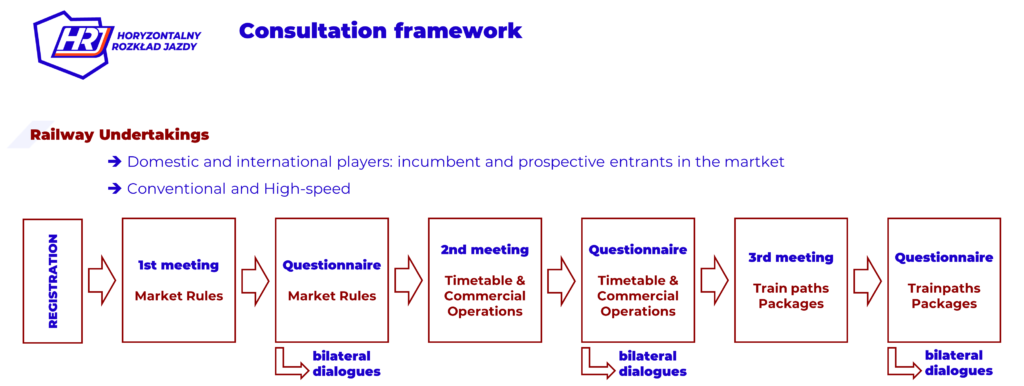
Detailed information regarding the consultation process with potential PSC operators and other rail operators can be found in the report. The report sets out, amongst other things, the positions of individual stakeholders, as expressed in the questionnaire and during bilateral meetings. It is worth emphasising in this context that the report is impartial – the HRJ Team has not included any comments or assessments in it, providing only summaries. The publicly available presentation and Report do not contain any information which, in the opinion of the HRJ Team, constituted confidential content and/or allowed for the unambiguous identification of a given stakeholder.
A summary of this consultation process can be found in the presentation:
https://hrj.gov.pl/wp-content/uploads/2026/05/Raport_konsultacje_HRJ_przewoznicy_kolejowi_operatorzy_Prezentacja_EN.pdf
Information about Horizontal Timetable consultation process can be found here.
International Consultations
One element of the consultation process under the Horizontal Timetable project was international consultations. They concerned primarily the layout of service lines between Poland and neighbouring countries, issues related to the organisation of these services, and conditions associated with the development of railway infrastructure on international corridors.
Unlike the other consultation paths, this cooperation has had, and continues to have, a continuous and less structured character, depending on activities carried out within various platforms and initiatives in which the Polish side participates.
The main purpose of the consultations is to develop and stabilise the international service network in HRJ, and to make the assumptions on the Polish side consistent with those of foreign partners. All activities are intended primarily to take into account and properly secure Poland’s interest in the harmonious development of existing and new connections with the rest of Europe.
Infrastructure is of particular importance in this context. In 2035, the new “Y” high-speed rail line to Poznań and Wrocław is expected to be put into operation, opening up new opportunities for both domestic and international services.
The current international service network, although developing steadily, is not considered sufficient. There is significant untapped potential on selected international relations which should be addressed in the planned service network for 2035. There is also noticeable interest from commercial railway undertakings in operating services on these relations and corridors. This must be reflected in plans concerning the use of railway infrastructure capacity on both sides of the border.
Horizon 2035 and the Horizontal Timetable project were subject to consultations within various cooperation platforms with foreign partners. Stakeholders included both infrastructure managers, such as the Czech Správa železnic, and ministries, including the German Bundesministerium für Verkehr and the Czech Ministerstvo dopravy.
Discussions were held in various formats, both during bilateral meetings and regular workshops organised as part of international initiatives. The cooperation took place with the participation of Polish partners, namely the Ministry of Infrastructure and PKP Polskie Linie Kolejowe.
Key formats of international consultations included the following:
EuroLink Initiative
EuroLink is a strategic initiative of RailNetEurope (RNE), an association of European railway infrastructure managers. It is a cooperation platform bringing together more than 20 infrastructure managers, established to jointly develop long-term cross-border service concepts for international traffic and capacity allocation across Europe.
EuroLink operates in the spirit of the new EU regulation on capacity management, known as CAP, and the TTR initiative — Timetable and Capacity Redesign. It focuses on a market-oriented approach and on maximising benefits for passengers and railway undertakings.
The main purpose of the initiative is to develop international services in Europe, in particular by harmonising the plans of individual infrastructure managers. The HRJ project is taken into account in EuroLink thanks to the involvement of Centralny Port Komunikacyjny and PKP Polskie Linie Kolejowe.
Bilateral Meetings at Ministry Level
The assumptions for international services in 2035, developed under the Horizontal Timetable project, were one of the elements discussed during various bilateral meetings with foreign partners at ministry level, attended by representatives of the HRJ project.
The meetings covered the Polish-Czech interface, with discussions concerning the organisation of services, and the Polish-German interface, with discussions focused primarily on coordinating the HRJ and DeutschlandTakt projects.
Capacity Planning by DB InfraGO under the Mittelfristiges Konzept für eine optimierte Kapazitätsnutzung (mKoK)
As part of the HRJ project, comments were submitted on the German Mittelfristiges Konzept für eine optimierte Kapazitätsnutzung (mKoK). This is a strategic tool of the railway infrastructure manager DB InfraGO, aimed at planning the use of railway line capacity over a 3–5-year horizon.
It is a medium-term tool, used before the assumptions of the DeutschlandTakt project are introduced. PKP Polskie Linie Kolejowe submitted official comments on the draft mKoK for 2028, with a perspective extending to 2030 and beyond. These comments were developed jointly, in line with the general objective of achieving the assumptions of the HRJ project.
Report on International Consultations (in Polish)
Information about Horizontal Timetable consultation process can be found here.