
Consultations with Potential Operators
Consultations with Potential Operators
Consultations with Potential Operators
One of the key elements of the ‘Horizontal Timetable’ project was a consultation with potential operators of Public Service Contracts (PSCs) and other rail operators interested in launching commercial services. The consultation involved both operators already operating in Poland and those interested in entering the Polish market. The consultations covered, in particular, issues such as:
- new rules for the organisation of public service transport (PSO – Public Service Obligation) in the domestic and international segments, planned for implementation from December 2030 following the expiry of the framework agreement with PKP Intercity and changes to Regulation (EC) No 1370/2007 introduced as part of the so-called Fourth Railway Package,
- the conditions and prospects for the development of commercial services,
- issues related to capacity management and train timetables, including the concept of a new mechanism for so-called predefined routes, formulated on the basis of traffic forecasts to ensure capacity for commercial transport, particularly on long-distance and international routes.
The knowledge gathered during the consultation is intended to inform the development of recommendations regarding the opening of the rail passenger transport market in Poland. They are also intended to result in the development of solutions for the public sector that will enable the creation of market conditions conducive to the development of competition and growth in transport volumes, as well as ensuring the protection of passengers’ interests and the stability of the market’s functioning. In addition, the Ministry of Infrastructure, through CUPT and in cooperation with Port Polska, will conduct preliminary market consultations under the Public Procurement Law, which will relate to the competitive selection of operators for interregional and international passenger transport services for the period 2030–2034.
Market opening should not be an end in itself, but a tool to improve the service offering for passengers and the functioning of the rail system. Simply announcing tenders for transport services or issuing decisions granting open access will not ensure that new players enter the market overnight. What is crucial is the creation of market conditions, as well as their stability and predictability, for which the state is responsible in relation to both subsidised and commercial transport.
Interested parties were able to take part in the consultations following prior registration, which was available on the project’s website until 31 August 2024. Prior to this, various stakeholders (both from Poland and other European countries) were actively encouraged to engage in this process – 53 individual invitations were sent out, and the project was presented at the World Passenger Festival in Vienna, one of the most important congress and trade fair events in the public transport sector. A total of 23 entities signed up to take part in the consultations, which should be considered a good result, as this represented the vast majority of operators from Poland and Central and Eastern Europe.
The first meetings with potential operators under PSC agreements and other rail operators interested in providing commercial services took place in early October 2024. These were introductory meetings at which the HRJ Project was presented and a substantive discussion was initiated. Following this meeting, a questionnaire was sent to the participants regarding key problem areas within the project. A total of 16 responses were received – 15 from rail operators and one from an industry organisation. In terms of country of origin, there were 7 Polish operators and 8 foreign operators. Six of these were entities operating exclusively in the long-distance sector, four exclusively in the regional sector, whilst five operated in both market segments. Taking into account their operations in their country of origin, these included both established operators (8 entities) and new market entrants (7 entities). In turn, in January and February 2025, bilateral meetings were held with 15 entities.
In total, the online and in-person bilateral meetings lasted over 32 hours and were attended by nearly 50 guests. During these meetings, it was possible both to clarify issues raised in the survey and to raise further topics.
The feedback gathered from 16 entities significantly supports the update of the assumptions for the project entitled ‘Horizontal Timetable’, though it does not cover all topics. Continuing the dialogue with the market is particularly necessary regarding the organisation of transport services following the launch of the KDP “Y” line: Warsaw – Central Airport – Łódź – Wrocław / Poznań, on which commercial transport is expected to take precedence over PSO connections.
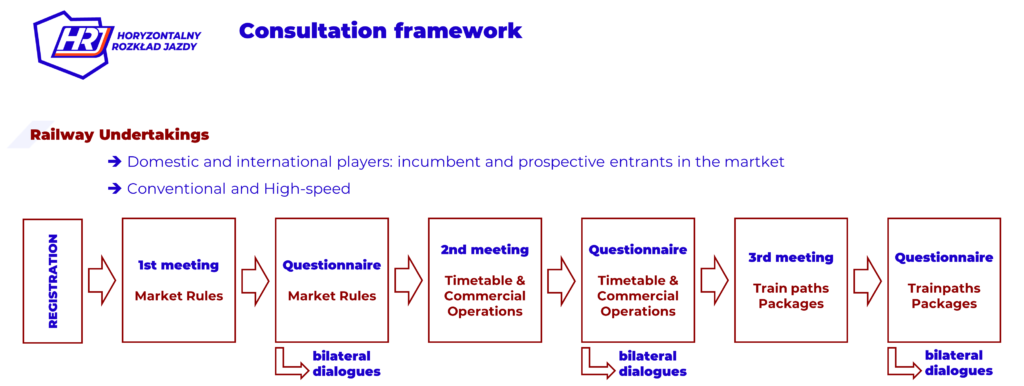
Detailed information regarding the consultation process with potential PSC operators and other rail operators can be found in the report. The report sets out, amongst other things, the positions of individual stakeholders, as expressed in the questionnaire and during bilateral meetings. It is worth emphasising in this context that the report is impartial – the HRJ Team has not included any comments or assessments in it, providing only summaries. The publicly available presentation and Report do not contain any information which, in the opinion of the HRJ Team, constituted confidential content and/or allowed for the unambiguous identification of a given stakeholder.
A summary of this consultation process can be found in the presentation:
https://hrj.gov.pl/wp-content/uploads/2026/05/Raport_konsultacje_HRJ_przewoznicy_kolejowi_operatorzy_Prezentacja_EN.pdf
Information about Horizontal Timetable consultation process can be found here.